Sunday, January 1, 2023

Taking Stock - Part Two - The Reality With a Preview of Things to Come

As you can probably guess, I am really excited about Old School Essentials. It's an OGL product and they have a handy instruction page right here. So this year, I will be looking at all of my products and reworking them into OSE-type products. 

Two of my works are perpetually frozen because they are too specific or too generic: 

1. The Hex Pack is too generic to rework in any meaningful way. It is what it is, a pack of colorful hex templates. It cannot change much, if at all. Unless someone asks me to change something, I won't. 

By the way, this title was changed based on feedback from a single person, so by all means, mention your needs. I do like feedback.

2. My Character Sheet for AD&D is linked specifically to Unearthed Arcana. The charm is that it's a scanned image of a character sheet created in the 80s. It is immune to change. 

Because they cannot change, I gave them their own little corner to the left side of the blog. 

That leaves my other 4 works that I would like to revamp. These are the two rule-agnostic mini-settings, Kobold's Folly and The Compass Rose Inn. These two don't have to change so I have also given them a less prominent spot on the left. I would like to flesh them out into actual modules for OSE. 

My first book should also get the OSE treatment, Zero to Hero: Uncommon Commoners. Ironically, it was written before I saw Old School Essentials. The professions listed in it are almost a verbatim match for the list that appears in those books. Realistically, it just needs editing down and to conform to the ability check mechanics as per those rules. Easy to say, but a rather lengthy project in execution.

The last title, The Swashbuckler Character Class bothers me. I am tempted to delete it. It is too heavily based on AD&D 1e, it is less than useful for B/X. Altering it would be like polishing a turd. 

I also have a couple other ideas. First, I am going to sit down and play some games. I have OSE, Battletech with some nice figures, and a couple of others I would like to feature here. Assuming I can get in the swing of this, I should have time to produce other content. 

Second, I have recently acquired a 3d printer. I need to learn how to produce models using it, mostly to supplement my games, but also to produce products to sell.  I might be doing terrain, robots, cars, characters, etc. I have no idea what I am doing, so we will see what happens.

Speaking of other content to sell, my OSE campaign will feed into a completely new project. 

Currently, I am reading a series of books called: A Handbook for Travellers in Northern Italy. It comes in 3 parts, northern, central, and southern Italy. Not only is it in the public domain, but it was also written in a strange time period before Italy unified into a single country. It was published in the mid-1800s, so it was only accurate for a decade or two. The editor goes out of his way to mention the publisher indirectly and never mentions his name or the names of the writing correspondents. 

This gives the whole thing a very odd but familiar vibe. Here are 3 books about a place we all know with passing familiarity, but it gives details that are not current, accurate, or even the whole story. On purpose... Probably because the publisher and editor realized the world was changing too fast to be a useful reference and didn't want to slap their names on it. They hide this with an air of humility.

It sounds like a D&D module. Theoretically, all modules exist within your homebrew campaign world with references to the goings-on of people who you don't know, but also theoretically exist in your campaign world. 

I hope to use these three books as a framework to produce modules and a campaign book for my homebrew campaign. It would come in two parts, a lore book which is directly modeled on those old handbooks of Italy, and the campaign book which would reframe the lore into specific modules and setting details that DMs with find useful. 

The funny bit is this stuff almost writes itself. Where the real-world handbook is cloaked in humility to sell copies, my version is written by an evil, selfish person working on heavy self-aggrandizement. As a sample, I offer the preface of this work: 

Volume One

PREFACE TO THE SEVENTH EDITION

═ ═ ═ ═ ═ ═ ═ ═ ═ ═ ═ ═

The length of time that has elapsed since the first publication of this (1274) Handbook has made many additions and alterations necessary.  The extension of roadways, trails, and ferries in several nations of the Northern portion of the Peninsula, important changes in the distribution, and descriptions of several Routes became indispensable. Some new Routes have been added. 

It has been the Editor’s endeavor to render this New Edition as a complete guidebook of the region that it professes to describe, as Drowishly possible; in doing so, I, Magarven the Great Traveller, must acknowledge my obligation to numerous kind Correspondents, Spies, and those who I have lavishly interrogated on numerous occasions, who have transmitted to me valuable, practical information for the purpose. These lesser people and contributors, second always to me as the Great Traveller, allow the author of this work to claim perfection. I must solicit from those who use THE HANDBOOK FOR TRAVELLERS IN THE NORTHERN PENINSULA, any additions, or forsooth, corrections, founded on personal experience, they may be able to transmit to me or any information generally of a practical character, useful to travellers on the Peninsula. Assuming, of course, that they are more correct than I am. Which is unlikely.  

I, Magarven the Great Traveller, the Editor Extrodinare of this work think that it is proper and just to leave out the name of the author who penned the first edition of The HANDBOOK FOR TRAVELLERS IN THE NORTHERN PENINSULA. That lesser person has had nothing to do with the six subsequent editions, except as regards those portions which were appropriated and rewritten, to an exceptional standard, through the hard work of myself and perhaps the few minor and lesser contributors who I have righteously selected as better correspondents than the original hack.

I warn the reader that any mistakes or misinterpretations of this guidebook must be attributed to the scribes or a failure of the reader’s intellect. As mentioned before, this is My greatest work, a simple and humble Perfection. 

Porto di Nazza, Juno, 1361


2023, I hope will be a very good year. While I doubt I will be able to meet every goal I've listed, having them spelled out will help me attain a couple of them. 

Saturday, December 31, 2022

Taking Stock: Part One The Game

Well, the solo sessions using Old School Essentials went south. It was the wandering monster list that did the party in:

1. Bandits, 3d4 appearing.
2. Sheep, 3d6 appearing.
3. Giant Ants, 2d6 appearing.
4. Ranger, 1 appearing.
5. Troll, 1 appearing.
6. Kobolds*, 3-6 appearing.
7. Mountain Goats, 2d4 appearing.
8. Mage*, 1 appearing.
9. Wild Horses, 1d4 appearing.
10. Wolves, 2d4 appearing.

Infi, I seem to be butting my head up against the concept of Random this week. I randomly rolled the number 3 several times too many. This is a rookie DM mistake and I shouldn't be a rookie DM 40 years in. Giant ants are far too imposing for 1st level characters to encounter. 

I'm equally a willy player and a willy DM, so I tried to make it work. Time was not on the PC's side, they have limited food and no capacity to heal magically. But they had other resources. 

In the first encounter, they faced 7 Giant Ants in an abandoned mansion. This played well as the party was naturally in 3 small groups with cover and the ants needed to advance on their positions. The Fighter, Halfling, and Elf all had bows while the Clerics had slings. The third group was the Magic-User and Thief with only melee weapons and spells. The MU cast light, drawing the first group of ants towards them. 

A halfling with a bow.
The rest of the party rained missiles down on them from two different positions. I had the ants roll modified morale. If they succeeded, the ants would pursue the FIRST person who shot at them. If they failed, they plowed on toward the MU and Thief. This had the effect of splitting the ants up and allowing the party a chance to shoot them from behind. Four ants fell to this tactic. When the party saw the next wave of 3 ants coming, they escaped to their hideout. 

This worked well except for the expenditure of arrows. This came back to hurt the party the next time. 

The party realized that the Thief was a better shot than the Fighter, so the bow was handed over.  

In the next combat, they encounter 4 ants in an alleyway. They downed all four ants in a hail of stones and arrows but lost one Cleric in the process. The party was also down just a handful of arrows. This is where slings shine as you can use any old rock as a missile. The party was dismayed when they returned to the mansion and the alleyway to recover arrows. They found the ones that missed their targets, but the ants carried off their dead, arrows and all. 

Later, the Party got bushwacked on a city street when the ants caught them again. The Fighter went down after a quick exchange of swings with the lead ant. The Halfling, Elf, and Thief took off to get a better angle on the Ants while the Magic-User and Cleric saved the day. The MU had an oil lamp in his hands and hit an ant on the first try, setting it on fire. The Cleric tossed a flask on the ant to finish the job. By now arrows were raining down. The party managed to kill five ants between missile fire and oil, but the Elf and Halfling were horribly wounded and the Fighter was dead. 

The party limped back home. The party was down by a lot: 3 characters dead, 2 injured badly.

The next day was better. They ventured out and encountered sheep. The Elf and Magic-User managed to kill two for food.  

They made one final foray, trying to make for the walls to get the heck out of this place. They were armed with torches and oil as they were out of arrows. They had one final encounter with 5 ants which was overwhelming despite the arsonist's mentality. Only the Thief and the last Cleric made it back to the fountain. 

The thing I like about this scenario is the mad card-playing Game Master randomly teleporting in new characters. I think this town has hopes as a good play environment so I want to keep it going. The petty little card cheater has unloaded another batch of heroes: a Half-Elf, a Paladin, a Cleric, a Fighter, a Thief, and a Magic User. Third level this time with a bunch of magic and good gear. Of course, I used the random Character Generator (Retainers), so all I need to do is name the party members. 

This post naturally leads to tomorrow's post about taking stock of my personal goals for the next year. 

PS: You can pick up a copy of Old School Essentials CharactersMagicMonsters, and Treasures on DriveThruRPG. You can also try Wordlographer before you buy.  

Friday, December 30, 2022

A Vance A. Study in OSE NPCs

In the last post about OSE, Vance A. commented that the Old School Essentials had character generators, specifically for NPC, Travelers, and so on. He didn't know how the distribution went, so I took a shot to figure it out. 

Before I dive into that, I would like to take a moment to thank Vance and anyone else who took the time to comment. I find that comments and shares are far better than a random like or emoji that I get elsewhere. Comments let me in on the mind of the readers and they are a report of the reception of posts I share. I love the comments, thank you very much.  

The best tool seemed to be the Retainer Generator. I set it to 0 percent chance for normal humans and asked it to generate 10d10 characters at 1st and 10d10 3rd level characters. I will repurpose them for my upcoming campaign and other projects, so I didn't burn electrons for nothing. 

I used my NPC breakdown sheet as a tally sheet. 

01-02 Acrobat (5)

03-04 Assassin (7)

05-06 Duergar (4)

06-15   Dwarf (2)

16-25    Fighter (7)

26-30 Half-Elf (3)

31-32    Half-Orc (0)

33-38 Halfling (0)

   39   Knight (7)

40-50 Theif (8)

   51      Svirfneblin (4)

52-73    Magic-User (10)

73-74    Illusionist (4)

75-80    Barbian (3)

   81      Bard (18)

82-92      Cleric (6)

   93  Drow (0)

   94         Druid (10)

95-97 Elf (0)

   98   Gnome (1)

   99   Paladin (2) 00   Ranger (10)


And you know what I discovered? Random is random. 


I generated 111 characters and this is just not enough to detect anything but the most basic trends. Certain classes and races seem more popular than others. However, judging by the 18 Bards I rolled, I could just be ascribing a personal point of view to a small series of choices. 


It was an interesting experiment in Random.


While this generator was meant for retainers, the resulting characters seem just fine for PCs. I'll be using them for that and more. You can check out all of the OSE generators at this link


Monday, December 26, 2022

Divine Donative - Bartering for Lives

For some strange reason, in all of my years of playing D&D, not one of my players has expressed a wish for the reincarnation or resurrection of a dead character. Not even the player of the deceased character. In fact, on the few times, one character has wished another character back to life, the player of the risen character has expressed some remorse at returning to the land of the living. 

I think I know why. Very often player characters in my campaigns ascend to a beloved NPC state. In other words, they retire. The story hasn't ended for them, but the adventure has. 

One idea that I am trying with my next campaign is "Divine Donative", an offering to a church, temple, or another group that ensures resurrection or reincarnation should something befall the character. Many of the rules in D&D are geared toward such a transaction such as an oath of poverty which requires donations. There is even a list price for the casting of such spells, so why not pre-payment as insurance. 

Hit x amount and you get free services. It stands to reason that if the character or party is funneling huge sums of money into an organization, there should be an immediate benefit.  At low levels, it's a bed for the night or minor healing. Later, after pounds and pounds of silver have been diverted to the organization, another life. 

We don't know what happened.
We think he liked rabbits.
Now for the fun bit. Usually, characters die from player burnout. They get bored or goofy and do something stupid to get killed. This moment of death could be an opportunity for a side mission. Everyone rolls up new characters and campaigns to recover the body. It's a nice little break and offers a chance to be something different than normal.  

Then there is the possibility that they pre-paid for services they do not want. But it's a contract that must be fulfilled. 

Off the church leaders go to save one of their most beloved patrons, and upon their return to the land of the living, this guy doesn't want to leave the temple grounds. He wants to tend a garden rather than scalp orcs. 

And if push comes to shove, maybe he or she refuses to come back as a human. All of a sudden, the party picks up a wolf or dog or cat as some sort of guardian. While the players wouldn't control such a beast, having one makes them special. 

Over time, if the characters donate enough, a willing person could be given some sort of magical jar that could be opened in a time of great need for the ultimate healing right on the field of combat. Think, a Pheonix Down from Final Fantasy. 

While I wanted to try this idea for end-of-life situations, the concept really should appear more in my campaigns. If characters are in some sort of guild or association that they support, that support should be two ways. Especially if the character is on track to be an epic hero of many storied deeds. People should be jumping out of the woodwork to support them. Even lowly fighters may belong to some sort of veterans group which could prove a small benefit if support. 

My idea isn't to just fork stuff out to the players as much build continuity with the campaign world beyond what the players are directly experiencing. If the party has a Bard or a Magic User, they probably have associations that need answers, which the PC might have. This would create a series of barter situations that the characters could grant favors and call them in later. Rather than present the party with a list of spells and costs, I should have them intervene if they can so as to curry favor with some group or another... or they could pocket the cash. 

I really like the idea of swapping this for that instead of a list of prices and services. It may take a bit to flesh the whole idea out, so I'm sure I will revisit it as time goes on.  

PS: You can pick up a copy of Old School Essentials CharactersMagicMonsters, and Treasures on DriveThruRPG. You can also try Wordlographer before you buy.  

Sunday, December 25, 2022

A Missing Bit from Old School Essentials - NPC characters

I noticed a tiny item missing from Old School Essentials: percentages of characters appearing. 

And... it immediately became obvious why this was missing. The original DMG was super weird about it and since OSE has many more character types, the whole thing goes sideways quickly. 

In the DMG, page 175 has a breakdown of an NPC for encounters of all dungeon levels. It lists all of the characters in almost alphabetical order and assigns a chance percentage to each. The table assigns a value of 9 for total party size and of those nine, 2-5 are classed characters. The remaining men are henchmen or men-at-arms. 

So, if one makes a table of characters found in Old School Essentials, you end up with three different tables. The first table would be for the basic rules, the second table would be advanced rules with race as a character class and the third table would be paired back to just the advanced character types, where race is something else. 

I love this quick table so I want one for OSE and I guess that means making one myself. I like it. 

But there is a hitch. The basic rules don't match my DMG because it has races as classes. Looking at the DMG does provide some guidance. It's ordered by class with subclasses appearing next. The table clearly shows that Fighters should be the most numerous characters in a party, followed by Magic Users, Clerics, and finally Thieves. All other classes have a tiny chance of appearing, between 1 and 3% each. 

But I am working with race as a class so there are no subtypes. There are a couple of ways to get a good list. If simply ballpark the numbers, a party should look like this: 

4 Fighters + 2 Magic Users + less than 2 Clerics + 1 Theif. Every other type has a tiny chance of appearing. Hmm, that is rather odd, but I can make it work. 

Instead of using the named class as a grouping, I am going to use my Pure, Square, and Semi models. A pure is someone who uses only uses magic to get stuff done. A Square is just like a Pure, but they use their muscle instead of skills or magic. Semis are someplace in between, using magic to supplement their skills or strength. Restating class as type, I end up with: 

5 Squares + 2 Pures + 2 Semi, all classes/races appear as one of these three classifications. This is interesting because it equates Thieves and Fighters, and separates Clerics from Magic Users from them. It is different but also allows Clerics to meet the standard of a "Fighting-man" while still being magical.  

Basic OSE has Cleric, Dwarf, Elf, Fighter, Halfling, Magic-User, and Thief.  I would group them like this with the following breakdown: 

5 Squares: Dwarf, Fighter, Halfling, and Theif, 
2 Pure: Magic-User
2 Semi: Cleric, Elf. 

That looks nice. I would order my list like this: 

01-13    Dwarf
13-36    Fighter
36-41    Halfling
42-50    Thief
51-71    Magic-User
72-86    Cleric
87-00    Elf

For Advanced OSE with race as class, we end up with a different list. 

5 Squares: Acrobat, Assassin, Duergar, Dwarf, Fighter, Half-Elf, Half-Orc, Halfling, Knight, Theif, and Svirfneblin.
2 Pure: Magic-User, Illusionist,
2 Semi: Barbian, Bard,  Cleric, Drow, Druid, Elf, Gnome, Paladin, and Ranger. 

Before assigning percentages, we'll create the same list with race as the class removed. It's easier to edit that way: 

5 Squares: Acrobat, Assassin, Fighter, Knight, and Theif.
2 Pure: Magic-User, Illusionist,
2 Semi: Barbian, Bard,  Cleric, Druid, Paladin, and Ranger. 

This one breaks down as: 

01-02    Acrobat
03-04    Assassin
05-06    Duergar
06-15    Dwarf
16-25    Fighter
26-30    Half-Elf
31-32    Half-Orc
33-38    Halfling
   39      Knight
40-50    Theif
   51      Svirfneblin
52-73    Magic-User
73-74    Illusionist
75-80    Barbian
   81      Bard
82-92    Cleric
   93      Drow
   94      Druid
95-97    Elf
   98      Gnome
   99      Paladin
   00      Ranger 

This one honors the original DMG list, but weakens both races and healing magic. I really had to mess with the numbers and it needs to be adjusted to specific campaigns. In my campaign, Half-Elfs are the default race while Half-Orcs and Drow are exceedingly rare. Those last two are literally 1 in 10,000 for NPCs. So, could totally monkey with the specific percentages. It's a good starting point for random NPC but bad for pretty much every individual campaign world.

The second list breaks down a little nicer than the first: 

01-08    Acrobat
09-10    Assassin
11-33    Fighter
  34       Knight
35-55   Theif
56-73    Magic-User
74-75    Illusionist
76-77    Barbarian
   78       Bard
79-94    Cleric
95-96    Druid
97-98    Paladin
99-00    Ranger 

And ultimately, I want the second list to generate some characters. So I roll a 2+1 for total of three characters. 77, 58, and 47 

We'll meet these three new characters in my next post. In the meantime, I have put together a couple of downloadable. The documents contain the lists above, plus a blank duplicate so you may enter your own probabilities. The 8.5x11 and A4 are two-column layouts and the A5 is just a single column as a Google doc. If you prefer, I have them in PDF, 8.5x11, A4, and A5

Merry Christmas! I hope you enjoy. 

PS: You can pick up a copy of Old School Essentials CharactersMagicMonsters, and Treasures on DriveThruRPG. 

Tuesday, December 20, 2022

Expanding the View - The Town of Manteva

I am continuing to work on this town, I think I have a name: Manteva. I am looking at some old maps of Italy and this one jumped out at me. Maybe it's misspelled, I don't know. 


We are looking at the southeastern edge of the town. I stopped the game in order to come up with some ideas for the flavor and layout of the town. I wasn't planning on a walled village, but it looks nice. 

Walls present some problems for generated maps. Computers are good at detecting collisions, but poor at the layout. Comparing this map to my last post, you'll notice some changes. First, there needs to be dead space around the walls, guard houses, and towers, otherwise, those bits don't work correctly. Providing cover to the enemy is bad, as is providing kindling for fire inside the walls. So, most of the trees have been pushed away from the structures. 

Stores, taverns, and inns should be near an entrance. Coopers and stables are good businesses to have near the gates. I like the Roman idea of bathhouses and outhouses, so this town has a couple. Furriers and smiths also appear near the gates. 

More interior to the town are market houses. These buildings have living space and shop space in the same structure. There is a public barn used for foodstuffs near the entrance. More than a few blocks contain public or private gardens. It looks like farmland, but really these would be a bit decorative and limited to herbs and small eatables like tomatoes. 

Since this is a fantasy town, the characters will find more than a couple of stationeries. Stationery shops sold books and paper. They were "stationary" because they didn't move on market day. The goods were too fragile. In addition to these types of establishments, there is also an Illuminator who would do the art for books. As a hidden feature, these shops are great for Clerics and Magic users. 

I've been labeling these so I can go back and populate each structure with a description. I can't wait to finish this town and move on to the next. 

PS: You can pick up a copy of Old School Essentials CharactersMagicMonsters, and Treasures on DriveThruRPG. You can also try Wordlographer before you buy.  

Saturday, December 17, 2022

Expanding Horizons with Worldographer - Solitary Sessions

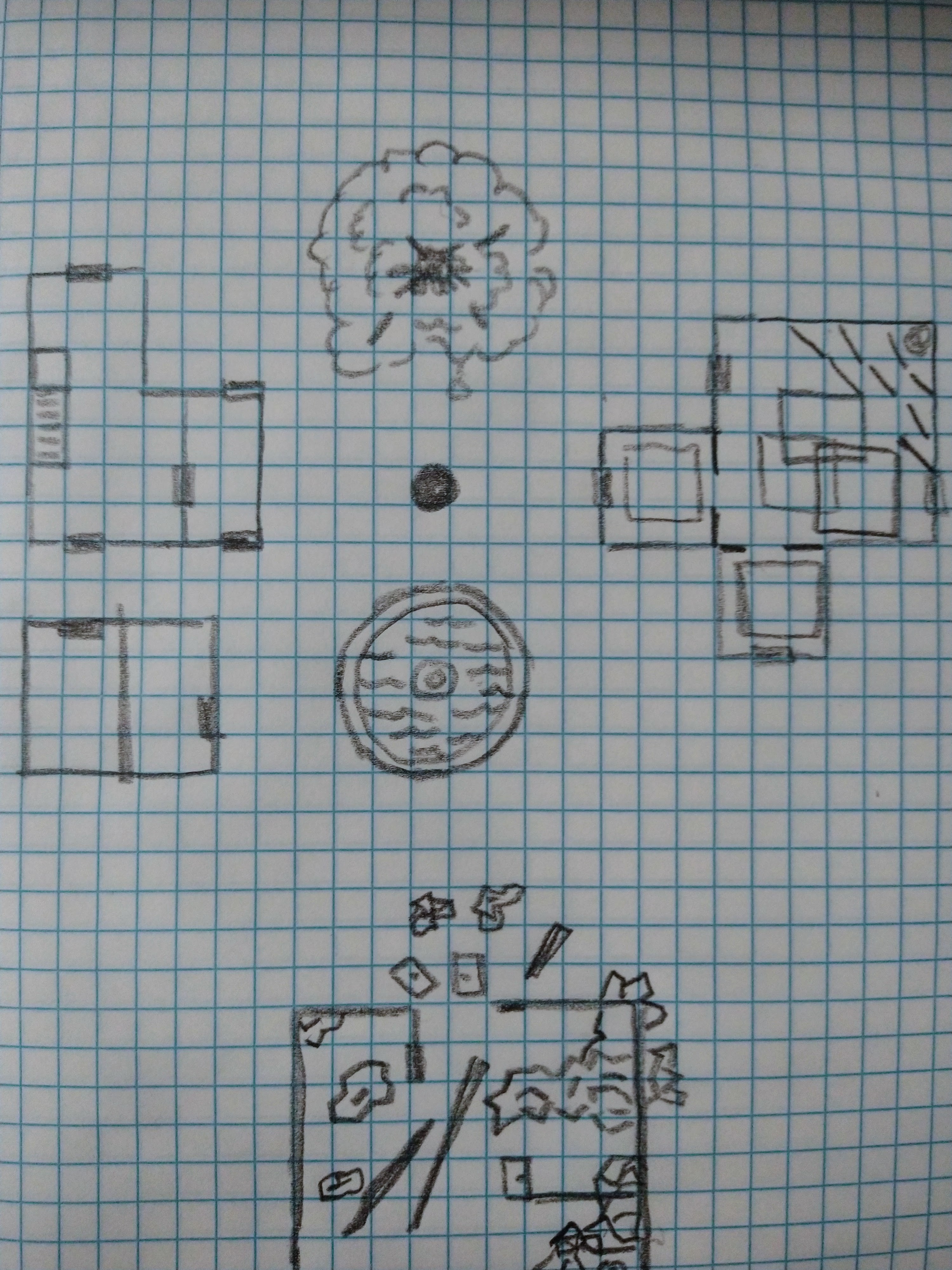
 I started working with Worldographer to flesh out the town the characters are exploring. 


Before the town was abandoned, it was home to 2,500-3,000 people.

This is an autogenerated map and I needed to add some details to make it match my hand-drawn map. I plugged in the fountain and tree while thinning out some of the buildings. 

The characters have explored all of the buildings around the fountain and tree. The three structures along the northern east-west road are 2 homes and a tailor's shop. The tailor's shop is interesting as the owner had a setup to dye cloth. 

The Party spotted horses and sheep around the barn just across the way. From the barn, they recovered a couple of large lanterns. The well in the northwest corner is in good working order and doesn't taste brackish like the fountain. The remaining buildings in this section are homes, which the Party skipped over. 

To the south, the Party bypassed the mansion. Every time they enter, the ants appear. I didn't place a ruined structure on the map yet. The roof is intact and that is just one more dimension for the ants to use in an ambush. The Party briefly consider burning it down but restrain itself. 

Directly across the street from the mansion is a blacksmith shop with nice a wagon out front. Inside the shop, they discover iron and silver ingots in addition to many weapons and tools. The Party returns to the general store to recover their supplies and bedding from the apartment. The blacksmith shop has an open floorplan which suits the Party's needs better than the shop. As the sun sets, the group takes some time to bring water from the well to their new indoor campsite. 

I might have time to explore more tomorrow. 

PS: You can pick up a copy of Old School Essentials CharactersMagicMonsters, and Treasures on DriveThruRPG. You can also try Wordlographer before you buy.  

Thursday, December 15, 2022

World Building - The Monster List

This has been a hectic week. I've been at work before the sun rises and long after it sets. But I am thinking about these sessions and this campaign setting. 

I didn't describe one building, the one shop directly to the left of the fountain. It's a shed-like shop, a summer building for the general store to its north. It has heavy up-swinging shutters that open to large counter displays. 

Presumably, the town was abandoned in the fall and the shop was shuttered. There are many knickknacks left over from the summer. Urns of summer wine are probably the thing that will attract the PCs, but also household items such as paintings, and small curios like necklaces and lockets. There are the odd socks and tights, soaps, and cleaning agents. And perhaps incense and candles.  

Again, the idea is to point to a once vibrant town. 

Since it was abandoned, it has been taken over by various critters, some of which have already been introduced. The characters have stuck to this one tiny area for several days. They don't realize the extent of the town but they feel comfortable where they are. 

It seems that I have misplaced my notebook, so I have recreated the wandering monster list from memory. Before we get to the wandering monster list, there are two types of monsters that do not wander: the catfish in the fountain and the green whip snakes which are busy brumation, the cold-blooded version of hibernating. 

The rules of engagement for the catfish are:  

1. There is a 1 in 6 chance that they will be visible. 
2. The catfish respond 1-3 rounds after a person enters the water if not immediately visible.
2a. They may be tricked into coming into range by dropping stuff in the water.  
3. If they need to flee, there is a hole in the fountain.  

The rules of engagement for the green whip snakes are: 

1. There is a 1 in 6  chance they will be found in any house. 
1a. They are everywhere, not finding them in one particular house doesn't mean they are absent, just undiscovered. 
2. They are brumating, so they will not wake unless held by a warm person or a fire is lit in the house. 
3. The snakes do damage by poison, not through biting. The poison causes muscle spasms, pain, and long-term shaking, all of which prevent using Thieves Skills and spell casting for hours. It is more annoying that anything else. 
3a. If the players decide to milk the snake for poison, it requires a Dex or Wis save the first time. After that it simply requires a plan and care. 

Now on to the main list: 

1. Bandits, 3d4 appearing. 
2. Sheep, 3d6 appearing. 
3. Giant Ants, 2d6 appearing.
4. Ranger, 1 appearing. 
5. Troll, 1 appearing. 
6. Kobolds*, 3-6 appearing.
7. Mountain Goats, 2d4 appearing. 
8. Mage*, 1 appearing.
9. Wild Horses, 1d4 appearing. 
10. Wolves, 2d4 appearing.

Starred monsters are singular creatures. 

The bandits hang out on the north side of town, this is a waypoint on their patrol range where it is generally safe to camp. Since there are no people here, they don't engage in looting and raiding activities here. They don't wander the town much as the trolls prey on men. None of them seem particularly skilled at combat, but they do have swords, bows, and light armor. They also don't have horses and have been warned about taking wild horses found in the as mounts or as pack animals. 

The sheep and goats are more amusing than a threat. They are feral, so hunting them is easy but treating them like farm animals will end in disaster. The funnier the better. The goats can be dangerous if mishandled. 

The giant ants have tunnels all around town. There is a 50-50 chance that characters encountering them will find a tunnel entrance near the encounter site. Inquisitive characters will find clues that indicate the ants arrived either after the town was abandoned or that the same time but not before, which means they were not the cause.  

The Ranger is an associate of the bandits. He is more daring in his explorations of the town than they are. He will avoid combat, if possible. Every season, he picks a new house to live in. When encountered, the characters might find him in his home. There is a 1 in 6 chance of this. 

There are several trolls hiding in the town, but only one is on patrol in the town at any one time. The troll will fight anyone he can for prestige and food, but like all trolls, he or she can be bought off. The Ranger pays rent, so they leave him and anyone with him alone. They also prey on horses, wolves sheep, and goats. If the characters offer them gold, the trolls will offer them housing. The trolls are brain-bustlingly dense. They will not accept animal carcasses as food, but if they are properly butchered, they will accept the meat and pelts as highly valued resources. It's like they don't know sheep are mutton. 8912                  
 
The Kobolds are of the Tribe of Minwan that hale from the Kobold's Folly. The Kobold party numbers six, but they may be encountered in smaller groups. The tribe is oddly friendly so long as they don't witness anyone abusing the wild horses. They care for the horses and will happily eat people who harm them. They are willing to trade with the party, they would like daggers, knives, and hatchets. The Trolls avoid them like the plague. These kobolds are very furry like a pug dog and taste horrible. The trolls don't want to offer them the opportunity of renting space in their town. 

The Mage is a singular person. He is mute yet can somehow cast spells. He has both clerical and arcane magic. He will heal characters in need. He can disappear and appear at random and often does. 

The wild horses and wolves are just typical beasts. They are comfortable in the town, but if put to flight they try to exit the town. They are not troubled by human dwellings, sometimes appearing inside buildings or peeking in open windows and doors. Obviously, this trait makes the wolves very dangerous. 

Introducing intelligent creatures into the town allows the characters a chance to dig for clues about the town. The troll, the kobolds, and the bandits will all be in agreement that the town has been abandoned for a long time. The trolls will term it as "forever" while the bandits and kobolds say, "many, many seasons". If trying to nail down a specific timeframe, it becomes obvious that the trolls and kobolds don't live very long so "forever", "many", and "seasons" may not mean much to them. The bandits don't recall a time that the town was inhabited and the individuals here aren't very knowledgeable. It seems that this is a newbie outing with only a few bandits having much experience at all.  

The Ranger has the most information which he himself finds to be odd. He indicates the town always appears to have been abandoned within the last 1 to 2 years, but he has been visiting the site for a decade. His mother and father knew of the place, so he feels like there is magic at work.